Last updated
Your Vinted margin is protected before you buy the item, not after a buyer sends a bad offer. Set a margin floor before sourcing, then check whether the purchase survives lower proceeds or extra preparation costs. Speed still matters, but only when the listing already fits the numbers.
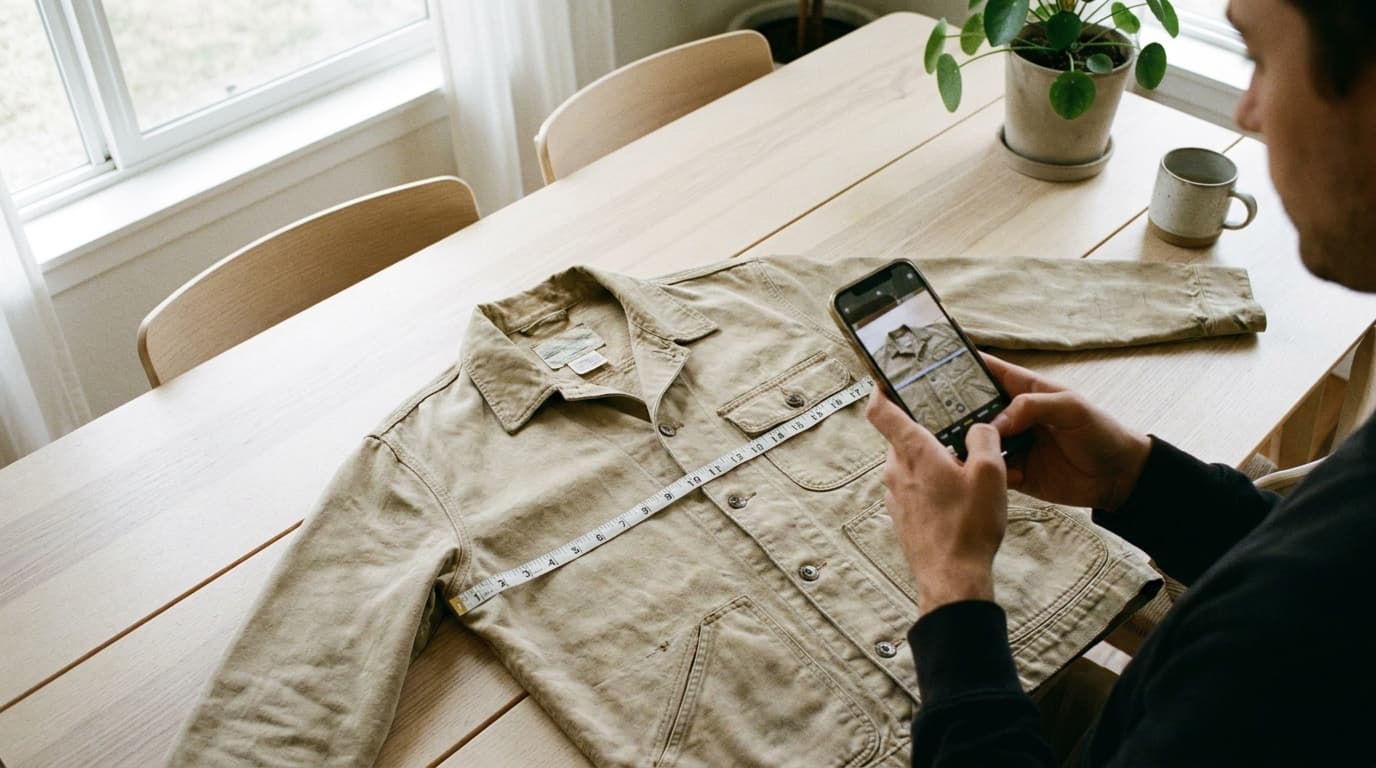
The cover and scene images are illustrations, not actual listings, product screenshots or transaction evidence.
Diagnose your stock before blaming the market
Slow sales can leave cash tied up even while a marketplace grows. Vinted’s company results do not prove that your category is saturated or that your next purchase will sell quickly.
Separate the problems you can act on: acquisition cost, unclear listing details, price, demand and time held. This guide is about sourcing economics. Use the listing checklist for presentation and the clear-out decision guide for personal belongings you already own.
What is your minimum Vinted margin?
Your minimum Vinted margin is the lowest profit you are willing to accept after all predictable costs, markdowns, and time are included. It is easy to calculate it too late. For example, a EUR 18 jacket imagined at a EUR 45 resale price still needs a budget for preparation, storage and possible markdowns.
If you are clearing your own wardrobe rather than sourcing stock, use the sell, bundle, or donate decision guide to decide whether a low-value item deserves a listing at all.

A simple margin floor looks like this:
| Line item | What to include |
|---|---|
| Buy price | Item cost, shipping to you, cleaning or repair if needed |
| Selling friction | Packaging, parcel drop-off time, failed buyer chats, likely discounts |
| Risk buffer | Smell, wrong sizing, slow category, damaged packaging, return dispute risk |
| Target profit | The amount that makes the buy worth your time |
Use this planning formula:
maximum buy price = realistic resale price - expected markdown - costs - risk buffer - target profit
Test the downside, not just the expected sale
Here is a hypothetical calculation, not a typical Vinted return:
| Input | Amount |
|---|---|
| Expected selling price | EUR 45 |
| Markdown allowance | EUR 5 |
| Other costs, including inbound charges and preparation | EUR 7 |
| Risk buffer | EUR 3 |
| Target contribution before tax and your time | EUR 12 |
| Maximum item purchase price | EUR 18 |
The ceiling is 45 − 5 − 7 − 3 − 12 = EUR 18. If you actually sell for EUR 35 after paying EUR 18 plus EUR 7 in costs, only EUR 10 remains before tax and your time. The target was missed even though the item sold above its purchase price.
Be consistent about units: this is a euro contribution per item, not a margin percentage or take-home pay. Include a time allowance if you want the ceiling to cover your labour. Avoid subtracting a markdown twice if your expected selling price already includes it.
If you buy goods for resale, check local business requirements and Vinted’s Pro guidance. In the UK, HMRC’s guidance uses combined gross trading income when discussing the GBP 1,000 allowance, not profit from each app. Tax and allowable-expense rules need their own calculation.
Build a buy box before you source
A buy box is a written rule for what you will buy. It is not a vague taste for "nice brands." It says the category, brand, size range, condition, maximum buy price, target resale price, and reasons to skip. The rule gives you a reason to pass on stock whose apparent discount does not survive the calculation.
A practical version:
| Buy-box field | Illustrative rule |
|---|---|
| Category | Men's wool coats, women's premium denim, kids' technical outerwear |
| Brands | Five to ten brands you can price from memory |
| Size range | Sizes that move in your market, not every size you can find |
| Condition | Very good or better, with no odor risk, stains, or missing labels |
| Maximum buy price | A number set by your margin formula, not by excitement |
| Skip rules | Bad photos, vague material, no measurements, fragile shipping, seller drama |
The point is not to make sourcing boring. It is to make your yes faster and your no easier. If a listing is outside the buy box, you do not need to debate it while someone else is watching the same search. You pass. If it is inside the box, you can act quickly because the decision was already made.

This is where filters help, but only after the buy box exists. Native filters are good for category, size, brand, condition, and price. You can mirror those with Vinted filters in InstantAlert so the alert starts from the same limits you would use by hand. Then consider keyword filters for terms relevant to your search: wool, cashmere, lined, new with tags, made in italy, or whatever fits the niche you know.
The opposite list matters just as much. Consider excluding a specific term when it repeatedly identifies stock outside your buying rules: kids, replica, dupe, stained, broken zip, needs repair, smoke, shein, cider, temu. Those terms do not establish a price or defect by themselves. For example, excluding stained can also hide “not stained”. Test a narrow exclusion before applying it to several alerts.
Use categories you can evaluate, and record uncertainty instead of pretending to know the market price.
How should resellers handle lowball offers?
Lowball offers are annoying because they feel personal. They are usually not. An offer tells you what that buyer is proposing; it does not establish the value of every comparable item. If you treat every offer as a comment on your judgment, the app becomes miserable. If you treat it as a pricing signal, it becomes useful.

Before you list, write down three numbers:
- Ask price: the number shown publicly.
- Counter price: the number you are happy to accept after a normal haggle.
- Walk-away price: the lowest number that still protects your margin.
Once those numbers exist, the offer decides itself. If the buyer is above the counter price, accept or counter once. If they are between counter and walk-away, counter calmly. If they are below walk-away, decline or ignore. No lecture. No paragraph about retail price. No emotional repricing because one person tried it.
For eligible standard-seller listings, bundle arithmetic can help assess an offer covering several pieces. A low offer on one item may be weak. A fair bundle across three related items can still protect the total margin because shipping feels better for the buyer and you clear multiple pieces at once.
The trap is lowering every item because bad offers keep arriving. That trains you to price for the worst buyer instead of the likely buyer. If an item has watchers but no sale, ask a better question: is the price wrong, are the photos weak, is the size hard, or did I buy outside my lane? The answer changes the fix. Sometimes the right move is a price drop. Sometimes it is new photos. Sometimes it is admitting the source buy was bad and using that lesson next time.
When is a listing ready for a buying decision?
A listing is ready to consider when it matches your buy box, the photos are good enough to check condition, the price leaves margin after a normal markdown, and the available seller and item information answers your questions. Speed alone does not make a listing good.
This is the part where alerts are useful, but also where they can hurt you if your searches are loose. A broad alert for "Nike jacket under EUR 40" will tempt you all day. Some of those jackets will be kids' sizes, replicas, damaged, fake vintage, or so common that the resale price is already flat. A tighter alert for a specific model, size range, material, and max price produces fewer pings, but each one deserves a real look.
The order of operations matters:
- Check the item against your buy box.
- Check the resale price from memory or a quick comp.
- Check the seller, photos, sizing, material, and flaws.
- Decide whether the margin survives one normal discount.
- Buy only if the answer is still yes.
Search alerts can help you notice new matches without manual refreshing. They do not remove judgment, and they should not. The win is getting to the right listing early enough to use your judgment before the crowd does.
The advanced Vinted filters playbook goes deeper on the mechanics: must-include words, must-exclude words, blocked sellers, and country filters. For a margin-first setup, I would use those filters to create fewer alerts, not more. Avoid alerts that only make you feel busy. Aim for the small number of listings where you already know the numbers work.
Protect Vinted margin by buying less, not more
Passing on an item can be sensible when its expected return does not cover the work and uncertainty. Decent stock ties up cash, fills storage, needs photos, attracts watchers, collects low offers, and slowly teaches you to accept thinner profit because you want the shelf space back.
Protecting Vinted margin means becoming harder to tempt. Buy fewer items with a clearer path to profit. Keep a sourcing note for every failed buy. Was the brand weaker than you thought? Did the size sit? Did the material photograph badly? Did every buyer ask for half off? That information is worth more than another random bargain.
Track five fields for each sourcing purchase:
- Buy price, including shipping to you.
- Expected resale price before listing.
- Final sale price after offers or markdowns.
- Days to sell.
- Reason it underperformed, if it did.
As records accumulate, compare completed sales with unsold stock. A small sample may suggest a question to test; it does not establish a dependable sell-through rate. That is when InstantAlert becomes more useful. You are no longer asking it to find bargains in general. You are asking it to watch for a narrow kind of item you already understand.
Before the next source purchase, write its ceiling and downside case. After the sale or exit, compare the result with that note. Keeping the failed buys in the record is what makes the next estimate useful.