Last updated
Vinted's own search is good enough to find a category, a brand, a size and a price ceiling, and then it stops. You can't exclude unwanted words from a query, there's no reusable seller blocklist across saved searches, and there's no country picker inside a single search. The advanced Vinted filters in InstantAlert add those four layers on top: must-include word lists, must-exclude word lists, blocked sellers, and seller country. I built these because I kept losing listings to noise: alerts firing on iPhone cases when I wanted phones, kids' clothes when I wanted adult jeans, and sellers I'd already been burned by once. So here's what each one actually does once you've been using it for a while.
In this post: Where Vinted's filters stop · Must-include words · Must-exclude words · Blocking sellers · Seller country
How does Vinted itself filter listings, and where does it stop?
Vinted's native search is more capable than people give it credit for. You get a keyword box, a category tree that goes several levels deep, filters for price range, size, brand, colour, material and condition, and a saved-search feature with a counter that tells you how many new items have been listed since you last visited. Vinted's own help on finding items lays it out: type into the search bar, refine with filters, save, come back later. For a quick "Levi's 501 in W32, under EUR 40, good condition" query, that's all you need.
If you already know the seller and only want to search what they have listed now, the free Vinted wardrobe search applies those native filters inside one public wardrobe. Saved alerts solve a different problem: watching for future listings.
What Vinted never built is the layer on top. There's no operator to exclude words, so a query for iPhone returns cases and chargers along with the phones. There's a per-account block button, but it works one profile at a time and isn't a list you can attach to a specific alert. There's no way to say "only show me listings from France and Belgium" short of switching to vinted.fr by hand. And no push notifications, only the counter you see when you reopen the app. InstantAlert mirrors the standard Vinted filter set (brand, size, price, condition, category) the same way Vinted does. The four filters in this post are the extra layer on top.
What does InstantAlert add on top of Vinted filters?
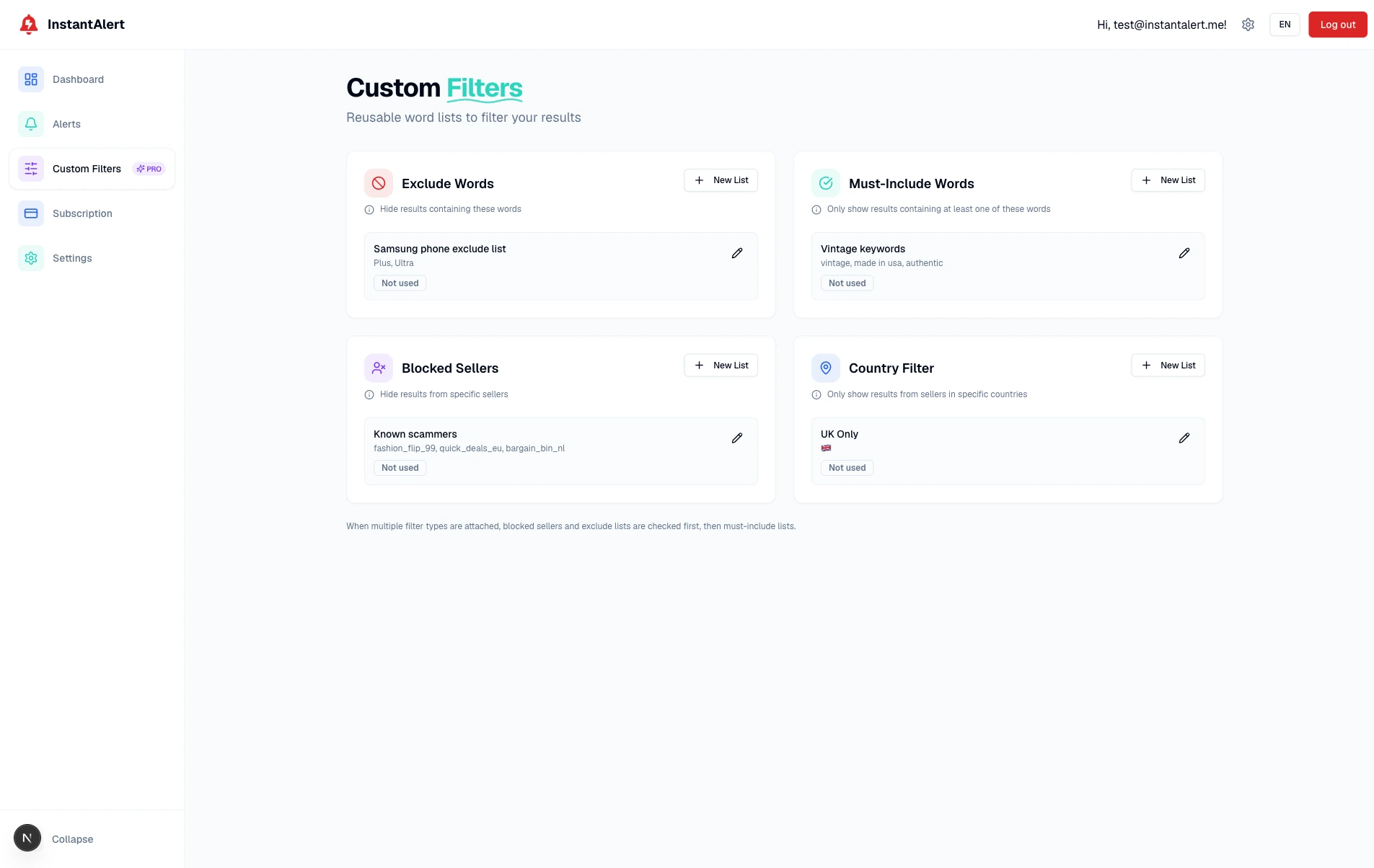
Four word-list filters, all reusable, all attachable to any saved alert: must-include words, must-exclude words, blocked sellers, and seller country. They're lists, not per-alert settings. You build a Vintage keywords list once with the variants you actually use, and you can attach that same list to five different brand searches without retyping. Same for a Known scammers list of usernames you've been burned by. The list lives in your account; the alerts borrow it.
The other shift is timing. Vinted's saved-search feature keeps a counter of new listings since your last visit, but you have to actually open Vinted to see it. The help page is plain about this: "You can save your searches and come back later to see if any newly uploaded listings match your search term." Coming back later is fine for a casual browse, but for the listings that sell in minutes, the round-trip to the app is the gap a faster buyer beats you on. InstantAlert pushes a notification the moment a match goes live, and the four filters here decide whether the listing actually counts as a match worth pinging you about. Alerting is about speed. The filters are about whether the thing is even worth your attention. Read how a saved search becomes an instant ping for the timing side, or use the Vinted alerts setup guide if you want the full alert workflow before tuning these filters. The rest of this post is the filtering side.
How do must-include word lists tighten a noisy search?
A must-include list is a set of words where at least one has to appear in the listing's title or description for the alert to fire. I mostly use it for brand variants. Take a search for denim jacket. On its own, that fires on every fast-fashion jacket with denim in the title. The version I run pairs the search with a must-include list of Levi, Levis, Levi's, Levi Strauss, Wrangler, Lee, Carhartt. The alert now only fires if the listing also mentions one of those brand names, and the noise drops by maybe 80%.
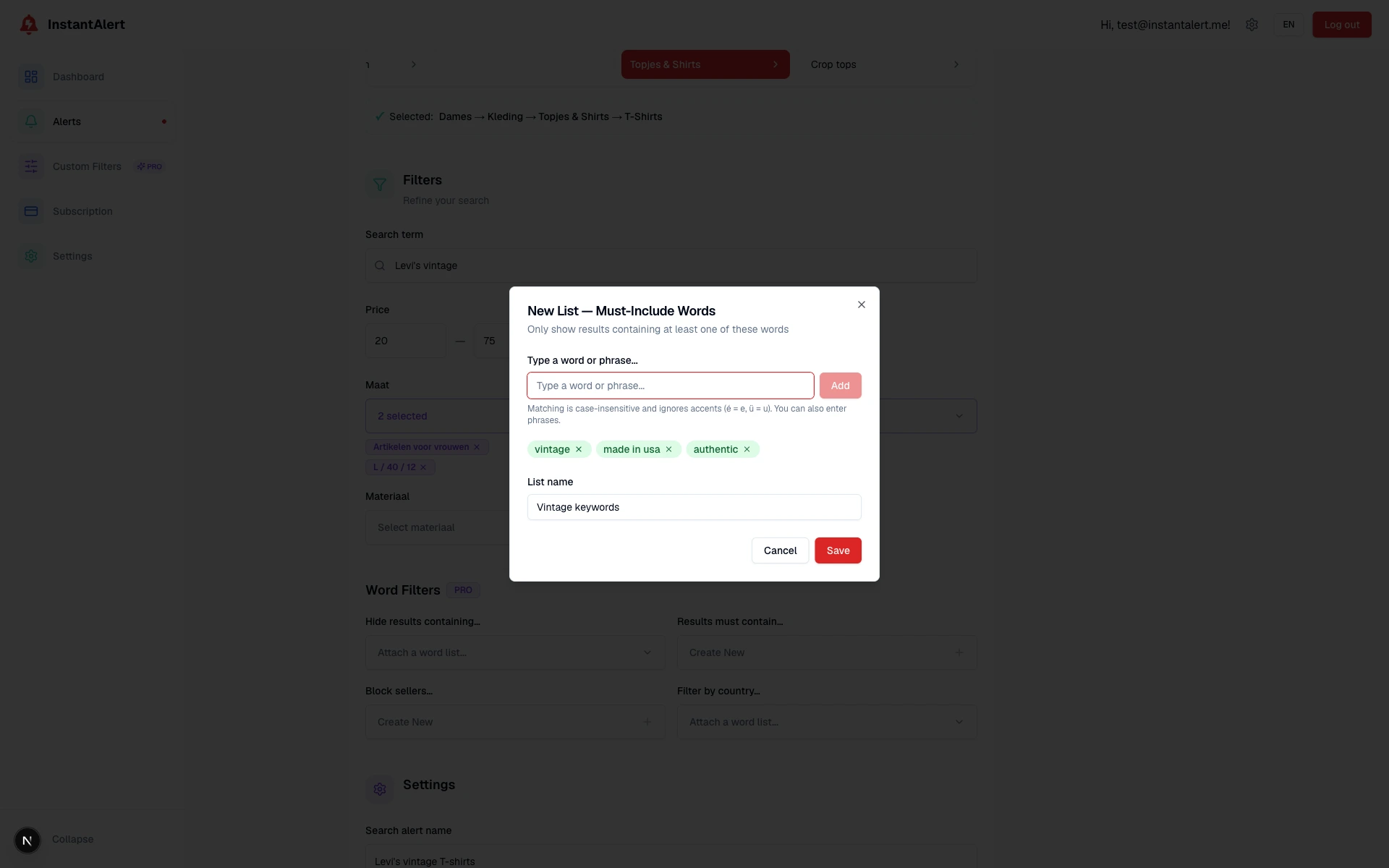
Where this really pays off is misspellings. Which? notes that misspelled brand names sell for less, specifically because "lots of sellers accidentally spell brand names wrong, which means fewer people find the listing, and prices are often lower." So a Levi's list that only contains Levi's with the apostrophe will quietly miss every seller who wrote Levis, Levi, or Levi Strauss. Put all the variants into one list and you catch the underpriced misspelt listings. I also keep a Vintage keywords list with vintage, made in usa, authentic, 90s, y2k, repro, because those are the descriptors that signal an older piece even when the seller never used the word "vintage". Build the list once and reuse it. That's the job the must-include and must-exclude word lists in InstantAlert are built around.
When is must-exclude the right tool?
Must-exclude is the mirror image. Any listing whose title or description contains one of the words on the list gets dropped before the alert reaches you. Take the iPhone problem: a clean search for the phone also catches iPhone case, iPhone charger, iPhone cable, iPhone screen protector, iPhone stand. A must-exclude list of case, charger, cable, screen, stand, holder, dock cuts those out. Same logic for a Lego search excluding instructions, manual, single piece, missing pieces. The list doesn't need to be clever, just specific to the long tail of accessories that show up under the same brand.
It's also how you filter out lookalikes. A search for a designer brand catches a lot of dupe, inspired, style, similar, replica, AAA, faux listings where the seller is open about it not being authentic. Drop those into a must-exclude list and the alert stops firing on them. Same trick for the children's-section problem with denim: kids, child, baby, boys, girls, age 4 come off because I'm buying for an adult. The prior post on the Vinted boom that fills your feed with noise covers why the feed got loud. This filter is how to survive it.
This isn't a new idea. MIT Libraries explains why exclusion narrows a search: "The NOT operator will exclude words from your search, narrow your search, telling the database to ignore concepts that may be implied by your search terms." A must-exclude list is exactly that, applied to listing text. Vinted's search box has no Boolean NOT, which is why this filter has to live one layer up.
Blocking repeat-offender sellers
Vinted does let you block individual members. Vinted's native member-block option is real: "The blocked member will no longer be able to send you messages or buy your items. Also, you'll no longer be able to see the member's items." What it isn't is a list you can build, edit, share between alerts, or apply selectively. It's a one-off per profile, applied platform-wide, with no easy way to audit what you've blocked or why. After a year of buying I had no idea who was even on my Vinted block list.
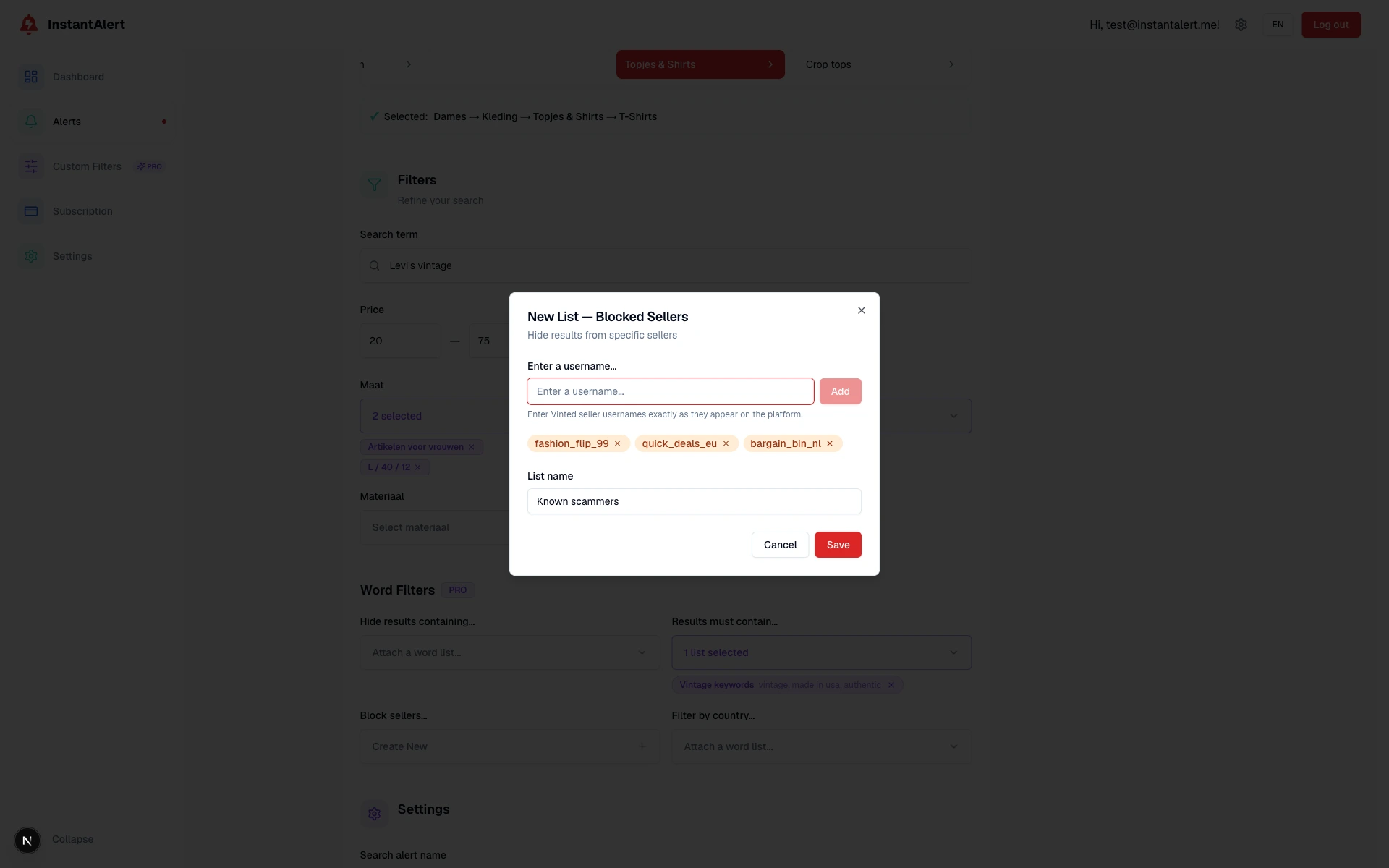
I have a Known scammers list I've added to over a year of buying, mostly sellers I got burned by once: item not as described on arrival, package that never showed up despite a "shipped" label, or a "Nike" hoodie with obvious fake stitching. There's a separate list for wholesale-pretending-to-be-personal-closets accounts and the ones who consistently overprice. Building a defensive list like that isn't paranoid. Which? found counterfeits widespread on Vinted in their 2024 investigation: "the highly convincing nature of these fake products means consumers could easily be caught out, putting their health and wellbeing at risk." Worth being honest about the limit, though. The list doesn't moderate anything. The seller is still on Vinted, still selling to other buyers. All the filter does is keep their items out of your own alerts. That's the job reusable seller-block lists in InstantAlert handle.
Why filter by seller country?
Vinted isn't one marketplace, it's twenty-plus separate ones, one per country, each with its own inventory pool. Vinted's 2025 results describe the spread: "Geographic expansion was achieved through launches in Latvia, Estonia and Slovenia, strengthening its European presence. Vinted Go Carrier now operates in five markets: Belgium, France, the Netherlands, Portugal and Spain." Each country domain (vinted.fr, vinted.de, vinted.nl, vinted.co.uk, vinted.es, vinted.it, vinted.be, and the rest) skews its inventory toward sellers in that country, but cross-border listings still leak in, and those ship slower, cost more, and sometimes hit customs friction (especially anything moving between the UK and the EU after Brexit).
The Vinted countries and connected regions map shows which source domains overlap and why changing the source can still change the results.
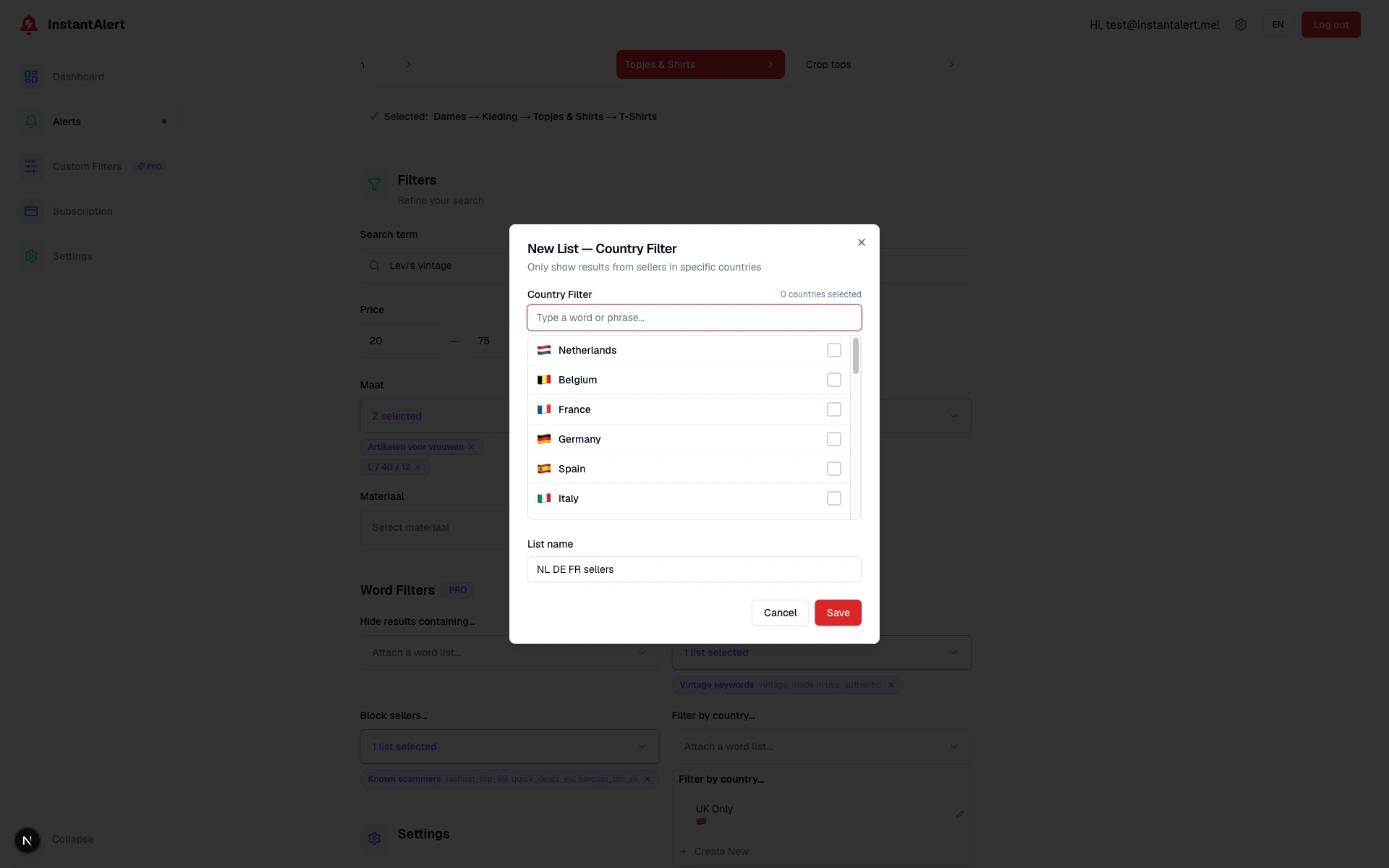
The country filter restricts an alert to listings shipping from countries you pick. I'm in the Netherlands. If I want a French vintage piece to arrive in a couple of days, I set the country filter to NL, BE, FR. Anything from Lithuania or Spain gets dropped, not because those listings are bad, but because the shipping windows don't work for the way I buy. Resellers use the same lever the other way around: a workwear hunter sets the alert to DE because German Vinted skews toward Carhartt, Engelbert Strauss and other workwear brands at lower prices. A streetwear flipper might point an alert at IT to source Italian-only inventory. The seller-country filter does it inside one alert, without juggling tabs.
Combining all four into a single Vinted alert
Here's what one of my real alerts looks like, end to end. Hunt: vintage Levi's jeans, my size, on vinted.fr. Native filters first: category = jeans, size = W30, price ceiling = EUR 50, condition = good or very good. Then the four word-list filters on top.
The must-include list is Levi, Levis, Levi's, 501, 505, 511, 517, vintage. That catches every spelling variant plus the four model numbers I actually want and the "vintage" keyword for older drops. Without it, the alert would fire on any pair of jeans in W30 at EUR 50, which is hundreds of irrelevant listings a week. The must-exclude list is kids, child, replica, dupe, repro, broken zipper, stained, hole. Children's sizes go. Lookalikes go. So do the listings where the seller has honestly admitted to a busted zip. The blocked-seller list is the personal Known scammers one I built over the past year. The country filter is FR, BE, NL, because a 2-3 day shipping window matters more to me than catching every European listing.
Once all four layers say yes, real-time alerts that ping the moment a match goes live handle the delivery and the notification arrives in seconds. After a couple of months running it this way, the honest result is roughly five to ten high-signal pings a week instead of forty noisy ones a day. Not all convert into a buy: sometimes the listing is gone before I open it, sometimes the photos look worse in person than in the thumbnail. But every ping is worth reading, and the ratio of opens to buys is closer to one in three than one in fifty.
Where these filters live in the plans
To be straight about it: the four word-list filters (must-include, must-exclude, blocked sellers, seller country) sit on InstantAlert's paid plans. They require Pro or above. The native Vinted-mirror filters (price, brand, size, condition, category), the real-time alert delivery, and saved searches are available during the 3-day free trial, which includes 3 total alerts. After that, a paid plan is required to keep alerts running. If your problem is signal-to-noise, with hundreds of listings a week burying the three you actually want, the four filters in this post are the reason the paid tier exists. InstantAlert's free trial and paid plans lay out which features sit at which tier.